
Iron casting is one of the oldest and most widely used metal manufacturing processes in engineering. From engine blocks and tractor components to valve bodies, pump housings, machine bases, and heavy industrial equipment, iron castings are used wherever manufacturers need complex shapes, mechanical strength, durability, and economical production.
But “iron casting” isn’t a single material or process. Different grades of cast iron have different graphite structures, mechanical properties, machinability, wear resistance, and applications. Choosing the correct type is therefore important for both product performance and manufacturing cost.
The most common types include gray iron, ductile iron, malleable iron, and alloy cast iron. Among these, gray iron and ductile iron are particularly important for modern industrial and OEM applications.
This guide explains what iron casting is, the main types of iron castings, how they are manufactured, how the different grades compare, and where each type is commonly used.
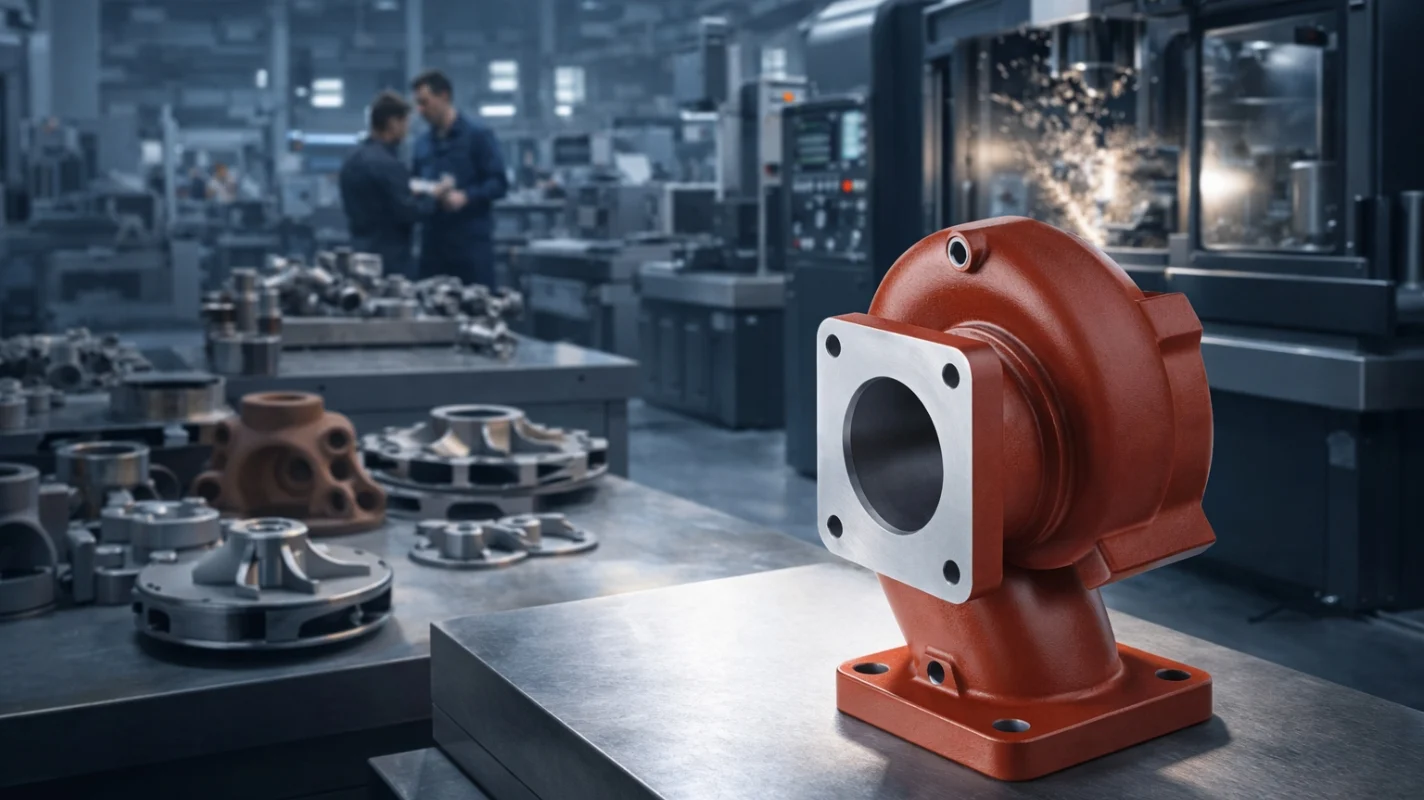
What Is Iron Casting?
Iron casting is a manufacturing process in which molten iron or an iron-based alloy is poured into a mold containing the desired component shape. After the metal cools and solidifies, the mold is removed and the casting is cleaned, inspected, and often machined to its final dimensions.
The basic process is:
Raw Material → Melting → Metallurgical Treatment → Mold Preparation → Pouring → Solidification → Shakeout → Fettling → Machining → Inspection
Casting is particularly useful for manufacturing components with complex geometries that would be difficult or expensive to produce by machining a solid block of metal.
Examples include:
- Engine blocks
- Cylinder heads
- Pump bodies
- Valve bodies
- Gear housings
- Differential cases
- Tractor components
- Machine bases
- Brake components
- Industrial equipment housings
The final properties of an iron casting depend on its chemical composition, graphite morphology, matrix structure, cooling conditions, heat treatment, and manufacturing process.
Why Is Iron Used for Casting?
Iron-based casting materials offer a combination of properties that makes them highly useful for industrial manufacturing.
Strength
Many cast iron grades provide sufficient tensile, yield, and compressive strength for heavy-duty components.
Wear Resistance
Selected iron grades can withstand friction and repeated mechanical contact, making them suitable for machinery components.
Machinability
Gray iron in particular offers excellent machinability, allowing manufacturers to produce accurate bores, holes, threads, and mounting surfaces.
Vibration Damping
The graphite structure of cast iron helps absorb vibration, which is valuable for machine bases, housings, and certain engine components.
Complex Geometry
Casting allows manufacturers to produce internal cavities, ribs, bosses, channels, and other features with relatively efficient material usage.
Cost Efficiency
For medium and high-volume production, casting can reduce material waste and machining requirements compared with manufacturing the same component entirely from solid stock.
What Are the Main Types of Iron Casting?
The term “types of iron casting” can refer to either different cast iron materials or different casting processes.
The material types most commonly discussed in engineering are:
- Gray Cast Iron
- Ductile Iron
- Malleable Cast Iron
- Compacted Graphite Iron
- Alloy Cast Iron
The casting processes used to produce these materials can include sand casting, investment casting, shell molding, and other specialized methods.
Let’s examine the major iron types individually.
1. Gray Cast Iron
Gray cast iron is one of the most widely used cast iron materials. Its name comes from the gray appearance of its fractured surface, which results from graphite flakes within the iron matrix.
The graphite flakes provide excellent machinability and vibration damping, but they also create stress concentration points. As a result, gray iron has relatively low ductility compared with ductile iron.
Key Properties of Gray Iron
- Excellent machinability
- Good vibration damping
- Good thermal conductivity
- Good compressive strength
- Good castability
- Cost-effective production
- Relatively low ductility
Gray iron is commonly used for components where high tensile ductility isn’t the primary requirement.
Common Applications
- Engine blocks
- Machine bases
- Pump housings
- Motor housings
- Brake components
- Flywheel housings
- Gear housings
- Industrial machinery
ASTM A48/A48M is a widely recognized specification for gray iron castings and classifies gray iron primarily according to tensile strength.
2. Ductile Iron
Ductile iron, also known as SG iron, spheroidal graphite iron, or nodular cast iron, was developed to provide greater strength and ductility than conventional gray iron.
The key difference is graphite morphology.
Instead of graphite flakes, ductile iron contains graphite predominantly in spherical or nodular forms. This reduces stress concentration and allows the surrounding metal matrix to carry mechanical loads more effectively.
Key Properties of Ductile Iron
- High tensile strength
- Higher ductility than gray iron
- Good impact resistance
- Excellent fatigue performance
- Good wear resistance
- Good machinability
- High structural reliability
Common Applications
Ductile iron is widely used for:
- Tractor components
- Differential housings
- Gear housings
- Steering components
- Hydraulic components
- Valve bodies
- Pump components
- Construction machinery
- Automotive components
- Heavy engineering parts
ASTM A536 covers ductile iron castings, while ISO 1083 provides classification requirements for spheroidal graphite cast irons.
3. Malleable Cast Iron
Malleable cast iron is produced by heat treating a suitable white iron casting to modify its microstructure.
The resulting material has greater ductility and toughness than conventional white iron.
Malleable iron was historically important for producing relatively small components requiring a combination of strength and machinability.
Typical applications include:
- Pipe fittings
- Brackets
- Agricultural components
- Automotive fittings
- Hardware components
- Mechanical connectors
Today, some applications that historically used malleable iron may instead use ductile iron or other materials because modern ductile iron production can provide greater design flexibility and mechanical performance.
4. Compacted Graphite Iron
Compacted graphite iron (CGI) occupies a position between gray and ductile iron in terms of graphite morphology and mechanical behavior.
Its graphite appears in compacted or vermicular forms rather than the flakes found in gray iron or the predominantly spherical nodules found in ductile iron.
CGI provides a combination of:
- Higher strength than gray iron
- Better thermal conductivity than many ductile iron grades
- Good vibration damping
- Good thermal fatigue resistance
It has become particularly relevant in demanding engine applications.
Common Applications
- Diesel engine blocks
- Cylinder heads
- High-performance engine components
- Heavy-duty powertrain components
5. Alloy Cast Iron
Alloy cast iron contains additional alloying elements that are intentionally introduced to improve specific properties.
Depending on the alloy system, elements such as chromium, nickel, molybdenum, copper, or other additions can be used to modify:
- Wear resistance
- Corrosion resistance
- Heat resistance
- Hardness
- Strength
- High-temperature performance
Alloy cast irons are therefore selected when standard gray or ductile iron doesn’t provide the required service performance.
Applications can include:
- Mining equipment
- Industrial wear components
- High-temperature machinery
- Chemical equipment
- Specialized engineering components
The correct alloy should be selected according to the actual operating environment rather than simply choosing the highest-alloy material.
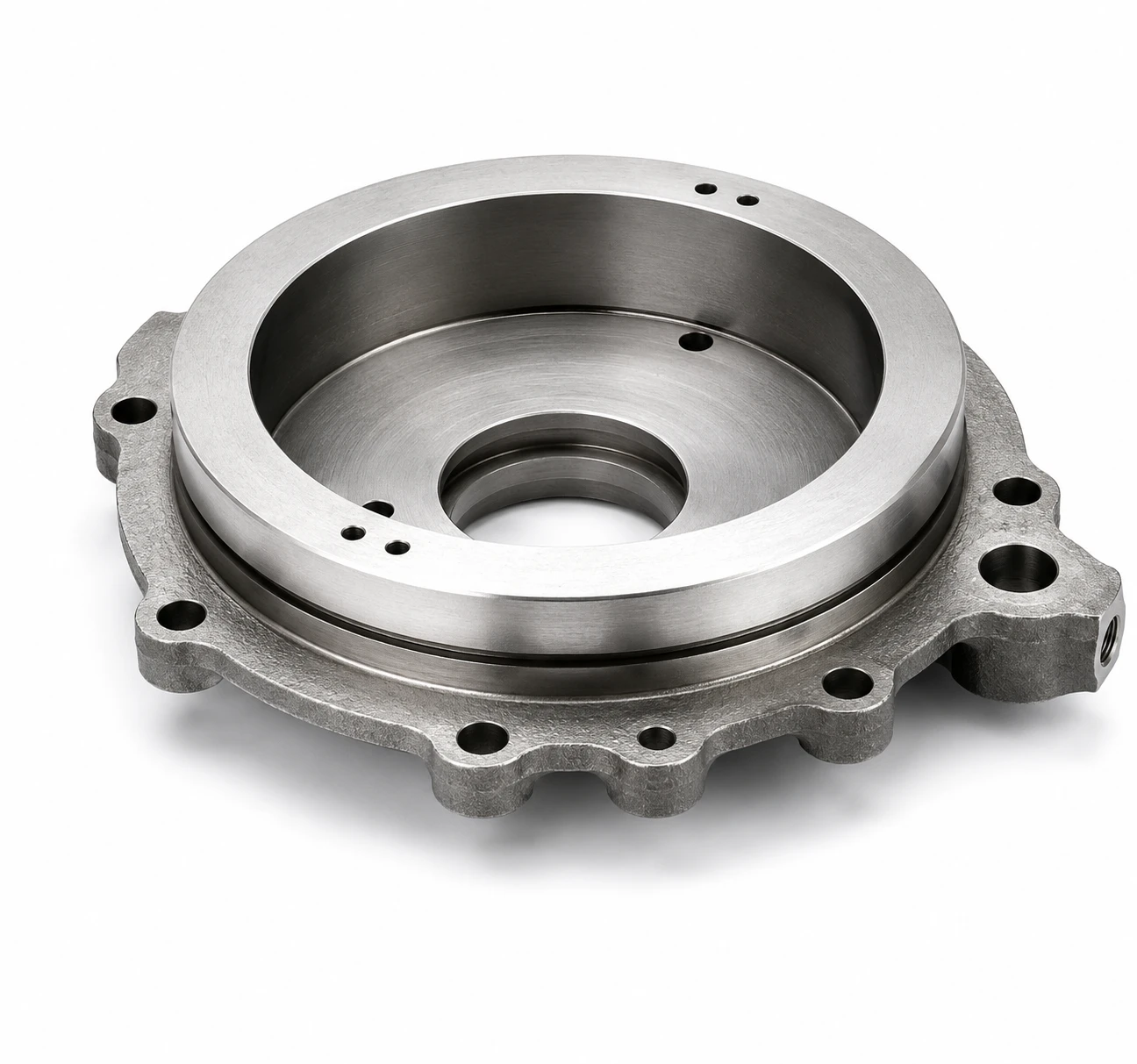
Gray Iron vs Ductile Iron vs Malleable Iron vs Compacted Graphite Iron (CGI)
| Property | Gray Iron | Ductile Iron | Malleable Iron | Compacted Graphite Iron |
|---|---|---|---|---|
| Graphite form | Flakes | Spherical nodules | Temper carbon | Compacted/vermicular |
| Ductility | Low | High | Moderate | Moderate |
| Tensile strength | Moderate | High | Moderate to high | High |
| Impact resistance | Low to moderate | High | Good | Better than gray iron |
| Vibration damping | Excellent | Good | Good | Good |
| Machinability | Excellent | Very good | Good | Moderate to good |
| Thermal conductivity | Good | Moderate | Moderate | Relatively high |
| Fatigue resistance | Lower | High | Good | High |
| Typical applications | Machine bases, housings, engine blocks | Automotive, tractors, valves, hydraulics | Fittings, brackets, hardware | Heavy-duty engine blocks, cylinder heads |
| Main advantage | Machinability and damping | Strength + ductility | Toughness and machinability | Strength + thermal performance |
What Are the Main Iron Casting Processes?
The material and the casting process are two different decisions.
A manufacturer may produce different iron grades using different molding and casting techniques depending on component size, geometry, production volume, and required accuracy.
Sand Casting
Sand casting is one of the most common processes for iron castings.
A pattern creates the mold cavity, and molten iron is poured into the prepared sand mold.
It is particularly suitable for:
- Large components
- Complex housings
- Tractor parts
- Pump bodies
- Valve bodies
- Machine bases
- Heavy industrial castings
Green sand and chemically bonded sand processes are commonly used for different production requirements.
Investment Casting
Investment casting uses a wax pattern that is coated with refractory material to create a detailed mold.
After the wax is removed, molten metal is poured into the resulting cavity.
It can provide:
- Complex geometries
- Fine details
- Good dimensional accuracy
- Reduced machining requirements
Investment casting is generally more attractive for smaller and more intricate components where the additional tooling and process cost can be justified.
Shell Molding
Shell molding uses a resin-coated sand mixture to create a relatively thin mold shell around a heated pattern.
Compared with conventional green sand molding, shell molding can provide improved surface finish and dimensional accuracy.
It can be useful for:
- Medium-sized components
- Repetitive production
- Components requiring better surface quality
- Precision industrial castings
How Are Iron Castings Manufactured?
Although the exact process varies according to the material and component, a typical iron casting production cycle includes several controlled stages.
1. Engineering and Casting Design
The manufacturer evaluates the component geometry and determines:
- Wall thickness
- Draft
- Core requirements
- Machining allowance
- Shrinkage allowance
- Gating
- Reserving
Good casting design helps prevent defects before production begins.
2. Raw Material Selection
The foundry selects appropriate charge materials such as pig iron, steel scrap, foundry returns, and alloying additions.
Chemical composition must be controlled according to the required material grade.
3. Melting
The charge is melted in an induction furnace or other suitable furnace.
Temperature and chemical composition are monitored throughout the process.
4. Metallurgical Treatment
The treatment depends on the iron grade.
For ductile iron, magnesium treatment is used to promote spheroidal graphite formation.
Inoculation can also be used to influence graphite formation and solidification behavior.
5. Molding and Pouring
Molten metal is poured into the prepared mold.
The gating system controls how metal enters the cavity, while risers provide feeding during solidification.
6. Cooling and Shakeout
The casting is allowed to solidify and cool before being removed from the mold.
7. Fettling
Gates, runners, risers, and excess material are removed.
The casting may then be shot blasted or otherwise cleaned.
8. Machining
Critical surfaces are machined to achieve the required dimensions and tolerances.
9. Inspection
Depending on the application, inspection can include:
- Chemical analysis
- Hardness testing
- Tensile testing
- Dimensional inspection
- Microstructure examination
- Non-destructive testing
Common Applications of Iron Castings
Iron castings are used across numerous industries.
Automotive
Applications include:
- Engine blocks
- Cylinder heads
- Brake components
- Transmission housings
- Differential cases
- Steering components
Agriculture
Tractors and agricultural equipment use iron castings for:
- Gear housings
- Transmission components
- Hydraulic parts
- Differential housings
- Structural brackets
Pumps and Valves
Cast iron and ductile iron are widely used for:
- Pump bodies
- Pump casings
- Valve bodies
- Covers
- Flanges
- Housings
Construction Equipment
Heavy machinery requires components that can withstand repeated loading and harsh environments.
Mining
Wear-resistant and high-strength iron castings can be used in demanding mining equipment.
General Engineering
Machine bases, motor housings, gearbox components, and other industrial machinery frequently use iron castings.
How to Choose an Iron Casting Manufacturer
Choosing a reliable iron casting manufacturer requires more than comparing prices.
Evaluate the foundry’s:
- Melting capacity
- Material expertise
- Molding technology
- Pattern and tooling capability
- Metallurgical control
- Machining capability
- Quality inspection
- Production capacity
- OEM experience
- Export capability
A capable manufacturer should also understand how casting design affects shrinkage, porosity, machining allowance, dimensional accuracy, and final component performance.
For OEM projects, ask whether the supplier can support the complete process from pattern development through finished machining and inspection.
Iron Casting vs Steel Casting
Iron casting and steel casting are not interchangeable.
Steel generally offers higher tensile strength and ductility, while cast iron can provide advantages in machinability, vibration damping, castability, and cost.
Iron castings can be particularly attractive when:
- Complex geometry is required
- Vibration damping is important
- High-volume production is expected
- Excellent machinability is required
- Cost efficiency is important
Steel may be preferable when the component requires particularly high toughness, tensile performance, or specific high-temperature properties.
The decision should be based on engineering requirements rather than assuming one material is always superior.
Why Choose RAIMAC Technocast for Iron Castings?
RAIMAC Technocast provides custom casting solutions for OEM and industrial component requirements.
Its casting capabilities can support applications involving:
- Gray iron castings
- SG / ductile iron castings
- Automotive components
- Tractor components
- Valve components
- Pump components
- Industrial machinery parts
- Custom OEM castings
For each project, material selection, casting design, production process, machining, and inspection requirements should be established according to the customer’s component specifications.
This approach helps ensure that the finished casting is not only dimensionally correct but also suitable for its intended operating environment.
Frequently Asked Questions
Iron casting is a manufacturing process in which molten iron or an iron-based alloy is poured into a mold and allowed to solidify into a desired component shape.
The major cast iron material types include gray iron, ductile iron, malleable iron, compacted graphite iron, and alloy cast iron.
Ductile iron can provide substantially higher tensile strength and ductility than conventional gray iron, but the strongest suitable material depends on the specific grade and application requirements.
SG iron means spheroidal graphite iron. It is commonly called ductile or nodular iron because its graphite forms predominantly as spherical nodules.
Neither is universally better. Gray iron is excellent for machinability and vibration damping, while ductile iron is generally better for applications requiring higher strength, ductility, and impact resistance.
Automotive, agriculture, construction, mining, pumps and valves, energy, transportation, and general industrial machinery all use iron castings.
Yes. Iron castings can be CNC machined to produce accurate holes, bores, threads, mounting surfaces, sealing faces, and other critical features.
For accurate quotation and production planning, provide engineering drawings or CAD models, material requirements, component weight, annual volume, dimensional tolerances, machining requirements, inspection requirements, and applicable standards where available.
Conclusion
Iron casting remains an essential manufacturing technology because it allows engineers to produce complex, durable, and cost-effective components at different production volumes.
The most appropriate type of iron casting depends on the component’s requirements. Gray iron provides excellent machinability and vibration damping, while ductile iron offers higher strength and ductility. Malleable iron, compacted graphite iron, and alloy cast irons provide additional options for specialized applications.
For OEMs and industrial buyers, choosing the right material is only the first step. The capability of the iron casting manufacturer is equally important. Controlled melting, accurate molding, metallurgical treatment, effective defect prevention, precision machining, and reliable inspection all contribute to the performance of the finished component.
A capable foundry can therefore help transform an engineering drawing into a consistent, production-ready casting that meets the mechanical and dimensional requirements of the final application.