
Choosing between gray iron and SG iron is not simply a matter of selecting the stronger material. The right casting depends on how the component will be loaded, how much ductility it needs, whether it must contain pressure, how it will be machined, and what service environment it will face.
Gray vs. SG Iron is therefore an important material-selection decision for manufacturers of agricultural machinery, industrial equipment, pumps, valves, automotive components, construction equipment, and other engineered products.
Gray cast iron is known for excellent machinability, vibration damping, and cost efficiency. SG iron, also called ductile iron or spheroidal graphite iron, offers substantially higher ductility and tensile performance because its graphite forms as rounded nodules rather than flakes.
So which one should you use?
The answer depends on the application. This guide explains the key differences between gray iron and SG iron, their manufacturing characteristics, properties, applications, costs, and the factors you should consider before selecting a casting material.
What Is Gray Cast Iron?
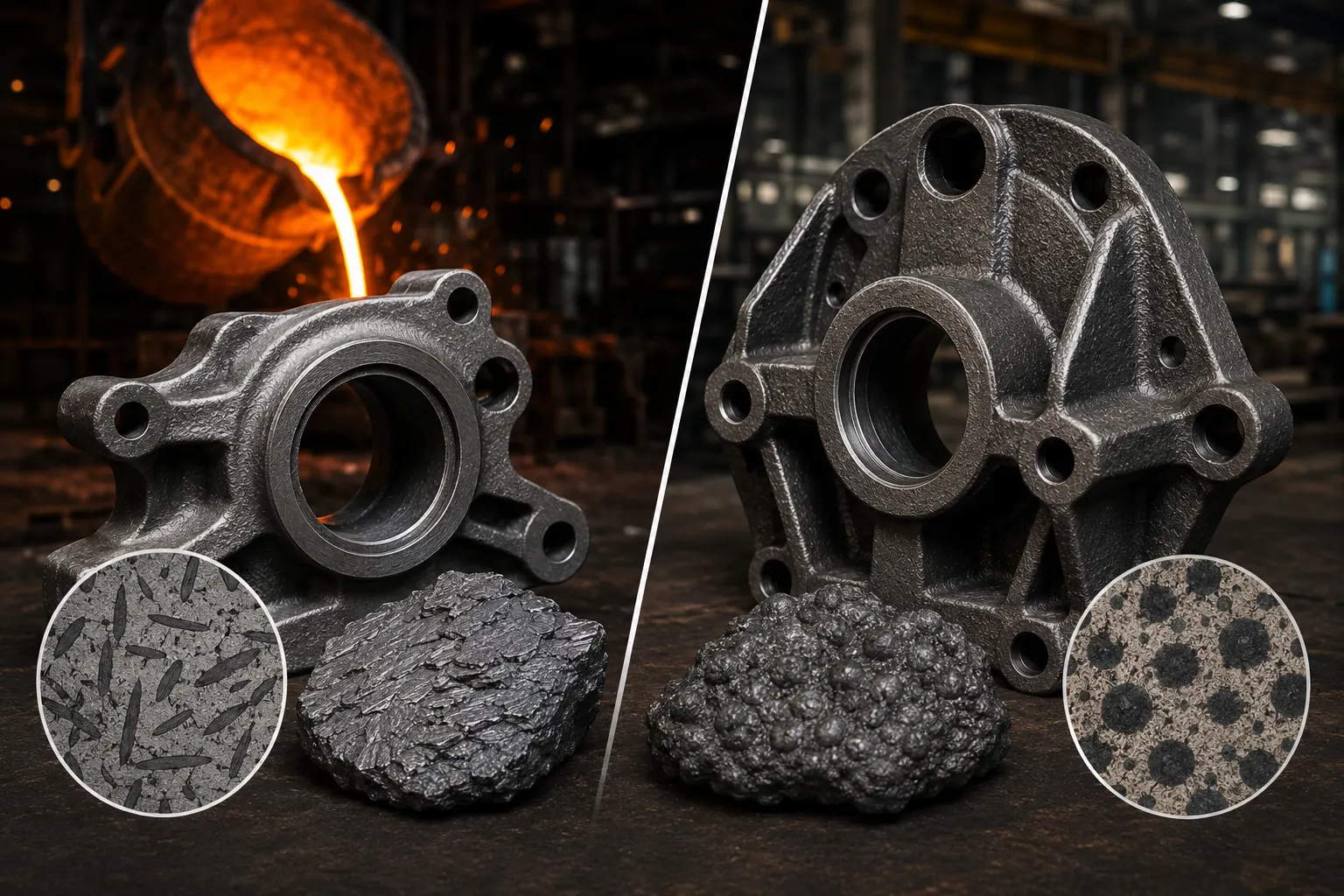
Gray cast iron is a ferrous casting material in which graphite forms primarily as flakes within the iron matrix. These graphite flakes give gray iron its characteristic appearance after fracture and contribute to several useful engineering properties.
The flake structure also explains one of gray iron’s main limitations. The sharp ends of the graphite flakes can act as stress concentration points. As a result, gray iron has relatively low ductility and is less suitable for components exposed to severe impact or tensile loading.
However, that doesn’t make gray iron a poor material.
For many applications, its combination of machinability, vibration damping, compressive strength, thermal conductivity, and relatively low cost makes it an excellent choice.
Typical gray iron applications include:
- Machine bases
- Pump housings
- Motor housings
- Brake components
- Engine components
- Industrial equipment
- General-purpose housings
- Low to moderate pressure valve components
ASTM A48/A48M is a widely recognized specification covering gray iron castings for general engineering applications, with classification based primarily on tensile strength.
What Is SG Iron?
SG iron stands for Spheroidal Graphite Iron. It is also commonly called ductile iron or nodular cast iron.
Unlike gray iron, SG iron contains graphite in approximately spherical or nodular forms. This morphology reduces the severe stress concentration associated with graphite flakes and gives the material much better tensile performance and ductility.
The result is a casting material capable of handling higher mechanical loads while retaining many of the manufacturing advantages of cast iron.
SG iron is commonly selected for:
- Gear housings
- Differential housings
- Hydraulic components
- Valve bodies
- Tractor components
- Steering components
- Automotive parts
- Construction machinery
- Heavy industrial castings
ASTM A536 covers ductile iron castings and specifies mechanical requirements such as tensile strength, yield strength, and elongation for its grades.
ISO 1083:2018 also classifies spheroidal graphite cast irons according to their mechanical properties and includes ferritic-to-pearlitic and solid-solution-strengthened ferritic grades.
Gray vs. SG Iron: Key Differences
The most important difference between the two materials is their graphite morphology.
| Property | Gray Iron | SG Iron |
|---|---|---|
| Graphite form | Flakes | Spherical nodules |
| Tensile performance | Moderate | High |
| Ductility | Low | Much higher |
| Impact resistance | Limited | Good to excellent |
| Fatigue resistance | Moderate | Higher |
| Vibration damping | Excellent | Good |
| Machinability | Excellent | Very good |
| Pressure applications | Limited to suitable grades/designs | Better suited to demanding applications |
| Manufacturing cost | Generally lower | Generally higher |
| Typical use | General engineering | Higher-load components |
The important point is that neither material is universally better. The best material is the one that matches the component’s actual service conditions.
Why Does Graphite Shape Matter?
Graphite morphology is at the heart of the Gray vs. SG Iron comparison.
In gray iron, graphite flakes interrupt the metal matrix. When tensile or impact forces act on the component, these flakes can concentrate stress and promote crack initiation.
SG iron is produced so that graphite forms predominantly as nodules. The rounded shape reduces stress concentration and allows the surrounding metal matrix to carry loads more effectively.
This is why changing graphite morphology can produce such a significant difference in mechanical behavior without changing the basic fact that both materials are cast irons.
For engineers, this means material selection should consider the type and direction of loading, not simply the nominal material name.
Manufacturing Gray Iron Castings
Gray iron production generally involves melting selected charge materials, controlling the chemical composition, preparing molds, pouring the molten metal, and controlling solidification.
Key production stages include:
- Raw material selection
- Induction melting
- Chemical analysis
- Temperature control
- Mold preparation
- Pouring
- Solidification
- Shakeout and fettling
- Shot blasting
- Machining
- Final inspection
Because gray iron has excellent fluidity and machinability, it is well suited to complex castings with features that require subsequent machining.
The foundry still needs careful control of carbon equivalent, inoculation, pouring temperature, mold quality, and solidification to maintain consistent mechanical properties and minimize defects.
Manufacturing SG Iron Castings
SG iron requires additional metallurgical control because the graphite morphology must be changed from flakes to nodules.
The production process typically includes:
- Charge material selection
- Induction melting
- Chemical analysis
- Sulfur and temperature control
- Magnesium treatment
- Inoculation
- Mold filling
- Controlled solidification
- Fettling
- Heat treatment when specified
- CNC machining
- Metallurgical and dimensional inspection
Magnesium treatment is particularly important. The treatment modifies graphite formation during solidification, while inoculation supports the development of a suitable graphite structure.
The final properties depend not only on the base chemical composition but also on factors such as matrix structure, nodule characteristics, cooling rate, section thickness, and heat treatment.
This makes SG iron production more metallurgically demanding than conventional gray iron casting.
Gray Iron vs. SG Iron: Strength and Ductility
If a component experiences significant tensile or impact loading, SG iron is usually the stronger candidate.
Gray iron can provide excellent compressive performance, but its low ductility limits its use in applications where the component may experience substantial deformation or impact.
SG iron provides a better combination of:
- Tensile strength
- Yield strength
- Elongation
- Toughness
- Fatigue resistance
The exact performance depends on the selected grade and casting section. Material standards should therefore be specified according to the actual component requirements rather than choosing a material based only on a generic property range.
Which Material Has Better Machinability?
Gray iron generally has the advantage in machinability.
The graphite flakes help break machining chips and can provide a lubricating effect at the cutting interface. This makes gray iron attractive for components requiring extensive machining.
SG iron is also machinable, but its greater strength and ductility can increase cutting forces compared with gray iron.
For high-volume production, however, the slightly greater machining challenge of SG iron may be justified when its superior mechanical performance allows the component to meet demanding service requirements.
Which Material Is Better for Vibration Damping?
Gray iron generally performs better when vibration damping is a major design requirement.
This is one reason gray iron has historically been used for:
- Machine tool bases
- Engine blocks
- Machinery housings
- Industrial equipment frames
The graphite structure helps dissipate vibration and contributes to dimensional stability in certain applications.
SG iron also provides useful damping characteristics, but its primary advantage is the combination of strength and ductility.
Which Is Better for Heavy-Duty Components?
For components exposed to repeated loads, impact, bending, or higher tensile stresses, SG iron is generally the more suitable choice.
Common examples include:
- Tractor housings
- Differential cases
- Steering components
- Hydraulic bodies
- Gear housings
- Heavy machinery components
- Pressure-containing castings
SG iron’s greater ductility provides additional protection against sudden brittle failure.
However, engineers should still select the specific grade based on the component’s design, load profile, temperature, wear requirements, and applicable specification.
Gray vs. SG Iron for Valve Components
Valve manufacturers often need to balance pressure requirements, machinability, cost, corrosion considerations, and service conditions.
Gray iron can be appropriate for certain general-purpose water and industrial valve applications where operating conditions are within the material’s design capability.
SG iron becomes more attractive when the component requires greater structural strength, impact resistance, or pressure capability.
For example, a valve body exposed to significant mechanical loading or demanding pressure conditions may benefit from the greater mechanical performance of ductile iron.
The final material decision should always consider the complete valve design and applicable pressure, temperature, and service requirements.
Gray vs. SG Iron for Agricultural Machinery
Agricultural equipment experiences vibration, shock, repeated loading, dirt, moisture, and changing operating conditions.
Gray iron can be suitable for relatively low-stress housings and components where vibration damping and cost are important.
SG iron is often better suited to components such as:
- Transmission housings
- Differential housings
- Lift components
- Steering parts
- Heavy-duty brackets
- Structural tractor components
For agricultural OEMs, SG iron can provide the durability needed for demanding field operation while retaining the casting flexibility required for complex component geometries.
Cost: Is SG Iron More Expensive Than Gray Iron?
In many cases, SG iron has a higher manufacturing cost because its production requires tighter metallurgical control, magnesium treatment, and additional process monitoring.
However, comparing material price alone can lead to the wrong decision.
A more useful calculation considers the total component cost, including:
- Casting cost
- Machining cost
- Rejection rate
- Service life
- Maintenance
- Failure risk
- Component weight
- Production volume
If a more expensive SG iron casting lasts significantly longer or prevents failures in a critical application, its overall cost may be lower over the product lifecycle.
How to Choose Between Gray and SG Iron
Before selecting a material, answer these questions:
1. What loads will the component experience?
High tensile, impact, bending, and cyclic loads generally favor SG iron.
2. Does the component require high ductility?
If deformation resistance and toughness are important, SG iron is usually the better starting point.
3. Is vibration damping a priority?
For machine bases and similar applications, gray iron can provide an advantage.
4. How important is machinability?
If extensive machining is required and mechanical loading is moderate, gray iron can be highly attractive.
5. Is the component pressure-retaining?
Pressure-containing components require careful material, casting quality, design, and testing decisions. SG iron may provide greater structural capability, but the complete design must determine suitability.
6. What production volume is required?
Both materials can support high-volume casting. The best choice depends on the required performance and total production economics.
OEM Gray and SG Iron Castings
OEM manufacturers often need more than raw castings. They may require complete support from pattern development through finished machining.
A capable casting partner can provide:
- Drawing-based manufacturing
- CAD model review
- Pattern development
- Prototype castings
- Material selection support
- Metallurgical testing
- CNC machining
- Dimensional inspection
- Surface finishing
- Production scaling
- Export packaging
For OEM projects, consistency is particularly important. A casting that meets specifications during prototype production must continue to meet those requirements throughout mass production.
How to Select a Casting Manufacturer
Whether you choose gray iron or SG iron, the quality of the foundry can be just as important as the material itself.
Look for a manufacturer with:
- Controlled melting facilities
- Chemical analysis capability
- Experienced metallurgical personnel
- Reliable molding processes
- Defect prevention procedures
- Heat treatment capability where required
- CNC machining
- Dimensional inspection
- Mechanical testing
- Traceability
- OEM production experience
A low-cost casting supplier may appear attractive initially, but inconsistent metallurgy, dimensional variation, or high rejection rates can quickly increase the real cost of procurement.
Why Choose RAIMAC Technocast?
RAIMAC Technocast supports OEMs and industrial buyers with precision iron casting solutions for demanding applications.
Our capabilities include:
- Gray iron castings
- SG / ductile iron castings
- Custom industrial components
- OEM casting production
- Pattern and tooling support
- Precision machining
- Quality inspection
- Export-ready manufacturing
The right casting material should be selected according to the component’s actual requirements. Our engineering and manufacturing approach focuses on matching material, casting design, production process, machining, and inspection requirements to the intended application.
Final Verdict: Gray or SG Iron?
There is no single winner in the Gray vs. SG Iron comparison.
Choose gray iron when your project prioritizes:
- Excellent machinability
- Strong vibration damping
- Good compressive performance
- Cost efficiency
- General engineering applications
Choose SG iron when your project requires:
- Higher tensile strength
- Greater ductility
- Better impact resistance
- Improved fatigue performance
- Higher structural reliability
- Demanding industrial applications
The most important decision is not simply choosing the stronger material. It is choosing the material whose properties match the actual operating conditions of the component.
For OEM and industrial applications, an experienced casting manufacturer can help evaluate the component design, loading conditions, material grade, casting process, machining requirements, and inspection criteria before production begins.
Frequently Asked Questions
Yes. SG iron generally provides substantially higher tensile strength and ductility than gray iron. The exact difference depends on the selected grades and casting conditions.
Generally, yes. Gray iron is known for excellent machinability and is often preferred when extensive machining is required and the component does not need the higher ductility of SG iron.
Yes. SG iron, spheroidal graphite iron, nodular iron, and ductile iron are commonly used names for the same general family of cast irons in which graphite is predominantly present in spheroidal or nodular form.
It depends on the component. Gray iron can work well for suitable housings and components where vibration damping and machinability matter. SG iron is generally more suitable for highly loaded structural, transmission, steering, and drivetrain components.
ASTM A48/A48M is used for gray iron castings, while ASTM A536 covers ductile iron castings. ISO 1083:2018 provides classification requirements for spheroidal graphite cast irons.
The choice depends on pressure, temperature, fluid, mechanical loading, applicable standards, and the valve design. SG iron can provide greater mechanical performance, while gray iron can be appropriate for certain general-purpose applications.